How Foreign Consignees Can Buy a Shipping Container in China and Ship It Together with Cargo
For many overseas buyers, purchasing goods from China is only one part of the shipping process. In some cases, the foreign consignee also wants to buy a shipping container in China, use it to load their purchased cargo, and then ship the container together to their destination country.
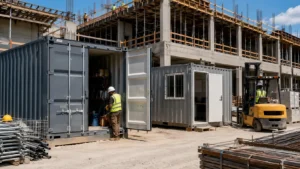
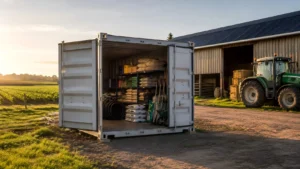
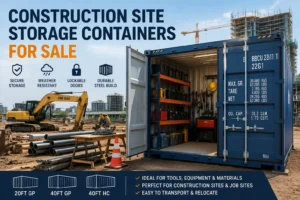
This solution is especially useful for buyers who need a container for long-term storage, warehouse use, farm storage, construction sites, mobile workshops, or private use after the cargo arrives. Instead of returning the container to the shipping line, the consignee owns the container and can keep using it after delivery.
In international shipping, this type of container is commonly treated as a Shipper-Owned Container, also known as an SOC container. Shipping lines may accept shipper-owned containers, but they normally require documents such as SOC application forms, container photos, and CSC plate photos before booking approval.
Why Foreign Consignees Buy Containers in China
China has many major container supply locations near export ports and industrial cities, such as Qingdao, Tianjin, Shanghai, Ningbo, Shenzhen, Dalian, Guangzhou, and surrounding manufacturing areas. This makes it convenient for foreign buyers to purchase a container near the supplier’s factory and arrange cargo loading directly.
For overseas consignees, buying a container in China can offer several advantages:
The container can be used as export packaging, sea freight equipment, and a long-term storage unit after arrival. It is also suitable when the buyer does not want to rent a carrier-owned container or when the container itself is part of the final purchase plan.
Common choices include:
| Container Type | Best For |
|---|---|
| Used 20GP Container | Small cargo, storage, private use |
| Used 40GP Container | General export cargo and warehouse use |
| Used 40HQ Container | High-volume cargo, furniture, panels, fencing, light products |
| New One Trip Container | Better appearance, long-term resale or storage use |
| Side Opening Container | Easy loading, wide cargo, equipment access |
| Customized Container | Office, workshop, storage, retail, or modified use |
For international movement, the container should be cargo-worthy and have valid safety approval. The International Convention for Safe Containers was created to maintain safety standards for containers used in transport and handling.
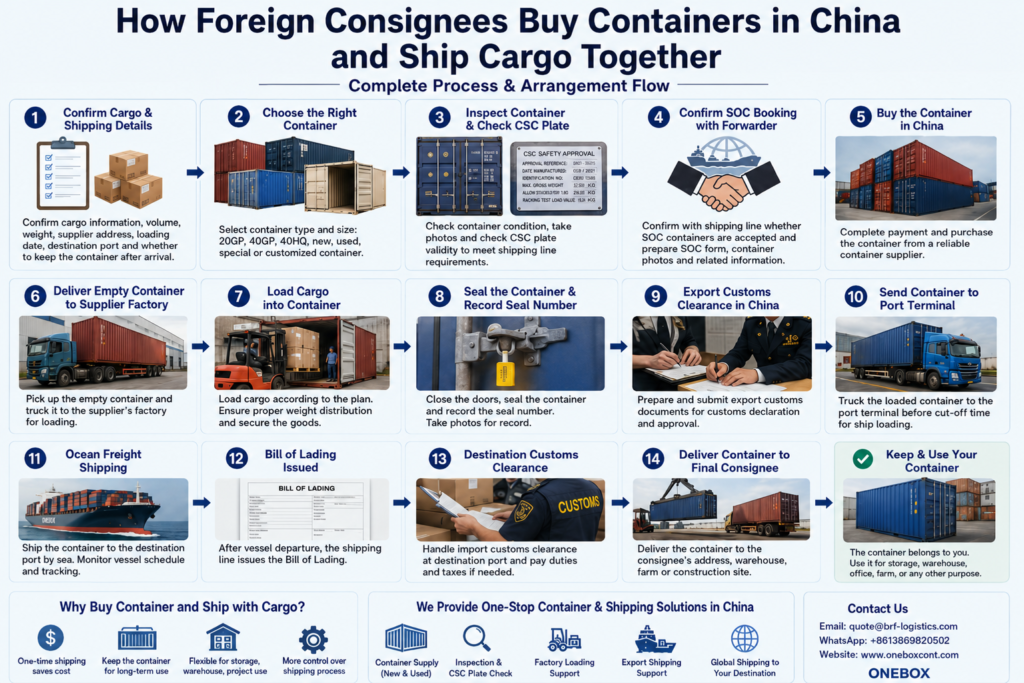
Step-by-Step Process: How to Buy a Container in China and Ship It with Cargo
1. Confirm the Cargo Details and Destination
Before buying the container, the overseas consignee should confirm the cargo information with the Chinese supplier or purchasing agent.
Important details include:
- Cargo name
- Total volume
- Gross weight
- Packing method
- Supplier factory address
- Loading date
- Destination port or final delivery address
- Whether the container will be kept by the consignee after arrival
This information helps decide whether a 20GP, 40GP, or 40HQ container is more suitable. For example, a 40HQ container is often preferred for lightweight but bulky cargo such as aluminum fences, acoustic panels, furniture, building materials, packaging goods, and household products.
2. Choose the Right Container Type
The next step is selecting the correct container. Most foreign buyers choose between a used cargo-worthy container and a new one-trip container.
A used container is more cost-effective and suitable for storage, warehouse use, construction projects, farm use, or private storage after arrival. A new one-trip container has a cleaner appearance, better condition, and is suitable for buyers who care about long-term value and presentation.
Before purchase, buyers should check:
- Container size
- Container condition
- Door seal condition
- Floor condition
- Rust level
- Water leakage test
- Locking bar condition
- CSC plate validity
- Container number and photos
The CSC plate is important because shipping lines normally need to verify that a shipper-owned container is suitable for international transport. Some carriers require SOC information, container photos, and CSC plate details before accepting the booking.
3. Arrange Container Inspection and Photos
A reliable container supplier should provide clear photos and inspection details before payment.
Recommended photos include:
- Front door view
- Left side and right side
- Rear view
- Interior floor
- Roof condition
- Door rubber seal
- Locking bars
- CSC plate close-up
- Container number
For foreign buyers, this step is very important because they may not be in China to inspect the container in person. A professional supplier such as ONEBOX can help check the container condition, confirm loading suitability, and provide inspection photos before the container is delivered to the factory.
4. Confirm SOC Booking Requirements with the Freight Forwarder
When a foreign consignee buys a container and uses it for export shipping, the shipment is usually arranged as an SOC shipment. This means the container is owned by the shipper or consignee, not by the ocean carrier.
The freight forwarder should confirm with the shipping line in advance:
- Whether SOC containers are accepted on the selected route
- Whether the container needs pre-approval
- Required SOC form
- Required CSC plate photo
- Container number format
- Container size and ISO code
- Gross weight and VGM requirements
- Origin port and destination port acceptance
Incoterms are important because they define the responsibilities of buyers and sellers for shipment, customs clearance, documents, costs, and risk transfer.
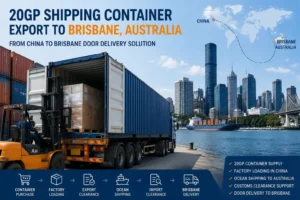
For this type of shipment, many foreign buyers work with a China freight forwarder to coordinate the container purchase, factory loading, export customs, sea freight booking, and destination delivery.
5. Deliver the Empty Container to the Supplier’s Factory
After the container is purchased and the shipping booking is confirmed, the empty container can be delivered to the supplier’s factory for loading.
The arrangement normally includes:
- Pick up the purchased container from the container yard
- Truck the empty container to the supplier’s factory
- Load the buyer’s cargo into the container
- Secure the cargo properly
- Seal the container
- Return the loaded container to the port or terminal
Cargo stuffing should be planned carefully. Proper loading, securing, dunnage, airbags, straps, and weight distribution help reduce cargo movement during road and sea transport.
6. Load the Cargo and Seal the Container
During loading, the supplier or warehouse team should follow a clear loading plan. Heavy cargo should be placed at the bottom, weight should be distributed evenly, and fragile goods should be protected.
The loading team should take photos during the process, including:
- Empty container before loading
- Cargo before loading
- Half-loaded container
- Fully loaded container
- Cargo securing details
- Closed container doors
- Seal number photo
The seal number must match the shipping documents. After the doors are closed and sealed, the container should not be opened unless required by customs or inspection authorities.
7. Export Customs Clearance in China
For export from China, the cargo supplier or export agent normally prepares the export customs documents.
Common documents include:
- Commercial invoice
- Packing list
- Sales contract
- Customs declaration documents
- Export license, if required
- Booking confirmation
- Container number
- Seal number
- Gross weight and cargo details
If the container itself is also being sold to the foreign consignee, the container purchase details may need to be clearly confirmed with the forwarder and customs broker. The container may be part of the shipment arrangement, and the cargo inside the container must be declared correctly.
8. Send the Loaded Container to the Port
After factory loading and customs preparation, the loaded container is trucked to the port terminal before the cut-off time.
The forwarder should monitor:
- CY cut-off time
- Customs cut-off time
- VGM submission
- Terminal entry
- Vessel schedule
- Estimated departure date
- Estimated arrival date
Good timing is very important. If the container is delivered late to the terminal, the shipment may miss the vessel and need to be rolled to the next sailing.
9. Ocean Freight and Bill of Lading
After the vessel departs, the shipping line or freight forwarder issues the Bill of Lading.
The Bill of Lading should correctly show:
- Shipper
- Consignee
- Notify party
- Port of loading
- Port of discharge
- Container number
- Seal number
- Cargo description
- Gross weight
- Number of packages
- SOC status, if applicable
For shipper-owned containers, the carrier may include SOC-related information according to its own documentation process. The buyer should confirm all details before the final Bill of Lading is released.
10. Destination Customs Clearance and Final Delivery
When the container arrives at the destination port, the consignee or local customs broker handles import customs clearance.
The consignee should prepare:
- Bill of Lading
- Commercial invoice
- Packing list
- Import permit, if required
- Duty and tax information
- Delivery address
- Container ownership confirmation, if needed
After customs clearance, the container can be delivered to the buyer’s warehouse, farm, home, construction site, or storage location. Since the consignee owns the container, there is no need to return it to the shipping line after unloading.
This is one of the biggest advantages of buying a container in China and shipping it together with cargo.
Complete Arrangement Flow
Here is the full process in a simple structure:
| Step | Arrangement |
|---|---|
| 1 | Confirm cargo details, supplier address, and destination |
| 2 | Choose 20GP, 40GP, 40HQ, new, or used container |
| 3 | Inspect container condition and CSC plate |
| 4 | Confirm SOC booking with freight forwarder |
| 5 | Buy the container in China |
| 6 | Deliver empty container to factory |
| 7 | Load cargo and secure goods |
| 8 | Seal container and record seal number |
| 9 | Arrange export customs clearance |
| 10 | Truck loaded container to port |
| 11 | Ship by sea freight |
| 12 | Handle destination customs clearance |
| 13 | Deliver container to final consignee |
| 14 | Consignee keeps the container for storage or reuse |
Why Work with ONEBOX for Container Purchase and Export Loading?
ONEBOX provides practical container solutions for overseas buyers who want to purchase containers in China and ship them together with cargo.
We can help with:
- Used and new shipping container supply
- 20GP, 40GP, 40HQ, and special container options
- Container inspection photos
- CSC plate checking
- Empty container trucking to supplier factory
- Factory loading coordination
- Cargo loading photo records
- Export shipping support
- Qingdao, Tianjin, Shanghai, Ningbo, Shenzhen, Dalian and other China port areas
- Sea freight support to the United States, Canada, Australia, New Zealand, Europe, and other global destinations
For foreign consignees, this service saves time and reduces communication problems between container yards, factories, truckers, customs brokers, and shipping companies.
Instead of dealing with multiple suppliers separately, buyers can use one coordinated solution: buy the container, load the goods, ship everything together, and keep the container after arrival.
FAQ
Can a foreign consignee buy a container in China?
Yes. A foreign consignee can purchase a new or used shipping container in China and arrange it to be loaded with goods for export. The container should be suitable for international transport and accepted by the shipping line.
What is an SOC container?
SOC means Shipper-Owned Container. It is a container owned by the shipper, consignee, or private buyer instead of the ocean carrier. Shipping lines often require approval documents and CSC plate photos before accepting SOC bookings.
Can I load my purchased goods into the container before shipping?
Yes. The empty container can be trucked to the supplier’s factory or warehouse, loaded with the buyer’s cargo, sealed, and shipped by sea.
What container size is best for export cargo?
20GP is suitable for smaller or heavier cargo. 40GP is suitable for general cargo. 40HQ is often better for bulky but lighter goods because it provides more internal volume.
Can I keep the container after it arrives?
Yes. If you buy the container, it belongs to you. After destination customs clearance and delivery, you can use it for storage, warehouse space, farm use, construction site storage, or private use.
What documents are needed?
Typical documents include commercial invoice, packing list, Bill of Lading, container photos, CSC plate photo, SOC form if required, export customs documents, and import customs documents at destination.
Conclusion
Buying a shipping container in China and loading it with cargo for export is a practical solution for foreign consignees who want both transportation and long-term container use. With the right supplier, freight forwarder, and loading plan, the whole process can be simple and efficient.
From container inspection and SOC booking to factory loading, customs clearance, sea freight, and final delivery, ONEBOX can help overseas buyers arrange a complete solution in China.
For buyers who need a container for export loading, storage, warehouse use, or long-term business use, purchasing a container in China and shipping it together with cargo is a smart and cost-effective choice.