Introduction: Don’t Just Use the Floor — Unlock the Vertical Space in Your 40ft Container
Many customers purchase a 40ft shipping container for storage, but the most common problem is not a lack of space. The real problem is that the available space is not being used properly. Tools are placed directly on the floor, cartons are stacked randomly, and materials become difficult to find. Over time, this can lead to damaged goods, wasted storage capacity, and safety risks.
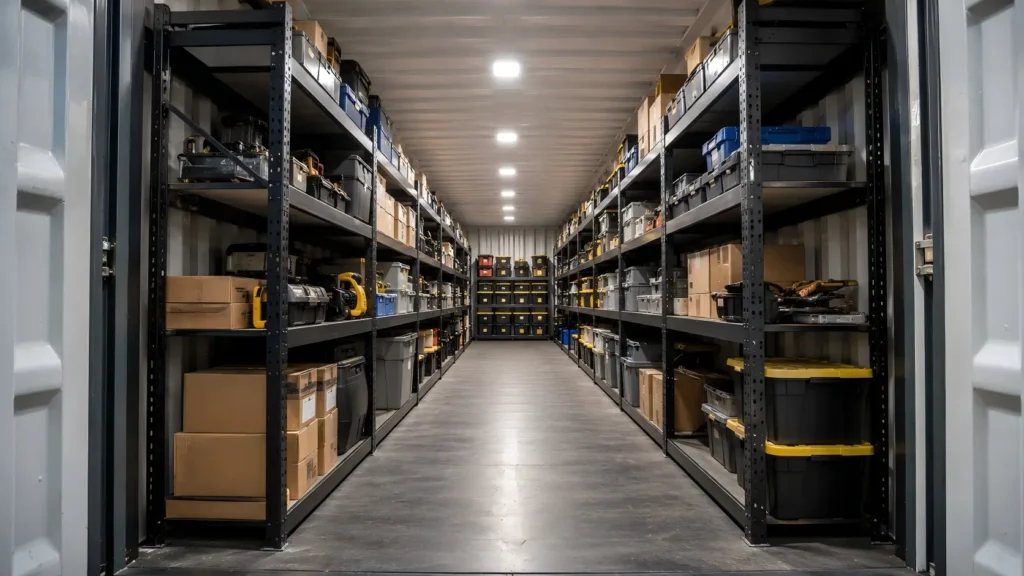
A 40ft shipping container is naturally suitable for conversion into a mobile warehouse, jobsite storage unit, farm equipment shed, or small inventory center. With the right heavy-duty shelving system, a standard container can be transformed from a simple storage box into an organized, efficient, and highly functional warehouse space.
For tools, machinery parts, farm supplies, packaging materials, e-commerce inventory, construction materials, and small equipment, container shelving can greatly improve storage efficiency by making full use of vertical space.
Why Is a 40ft Container Ideal for Heavy-Duty Shelving?
A 40ft shipping container offers strong steel construction, excellent length, secure enclosure, and flexible modification options. Compared with traditional warehouse buildings, container storage is movable, cost-effective, fast to deploy, and suitable for many industrial and commercial applications.
After installing heavy-duty shelving, a 40ft container can provide:
Higher space utilization, because goods are stored vertically instead of only on the floor.
Faster picking and inventory access, because products can be organized by category, zone, and shelf level.
Lower risk of product damage, because heavy goods can be placed on lower shelves and lighter goods on upper shelves.
Better inventory control, because each shelf area can be labeled and managed more clearly.
A safer working environment, because aisles remain open and goods are less likely to collapse or block access.
If you plan to use a shipping container as a long-term storage unit, a shelving system is one of the most valuable upgrades you can make.
Step 1: Decide Between Permanent Shelving and Removable Shelving
Before buying or installing shelving, you should first understand how the container will be used in the future. Different storage purposes require different shelving structures.
Permanent Shelving for Long-Term Storage
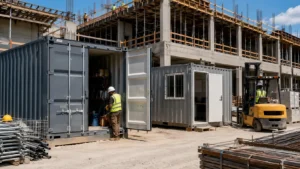
If your 40ft container will stay in one location for a long time, such as a construction site, farm, factory, repair workshop, warehouse yard, or commercial storage area, permanent shelving can be a stable and durable option.
Permanent shelving is suitable for:
Construction tools and jobsite materials
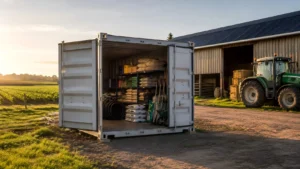
Farm equipment, supplies, and repair parts
Hardware, mechanical parts, and spare components
E-commerce inventory and packaging materials
Long-term commercial warehouse storage
This type of shelving is stronger and more stable. It can also be customized according to the size, weight, and category of the goods. However, before installation, you should carefully consider door access, loading paths, lighting, power supply, ventilation, and whether you may need additional roll-up doors or personnel doors in the future.
Removable Shelving for Flexible Use
If your cargo types change frequently, or if you may resell the container, move it to another site, or convert it for another purpose, removable shelving may be a better choice.
The advantages of removable shelving include:
Adjustable shelf height
Easy removal or layout change
Less impact on container resale value
Suitable for seasonal goods and temporary projects
Simpler installation and maintenance
For customers who are not sure about their long-term storage plan, it is often better to start with shelving on one side of the container. This improves storage capacity while keeping a wide main aisle. Additional shelving can be added later if needed.
Step 2: Choose the Right 40ft Container Type
The final shelving result depends not only on the shelf system, but also on the container type. The two most common options are a standard 40ft container and a 40ft High Cube container.
Standard 40ft Container
A standard 40ft container is suitable for most storage needs, including tools, cartons, spare parts, packaging materials, household storage, farm supplies, and general commercial goods. Its long floor space allows shelving to be installed along one side or both sides.
40ft High Cube Container
If you need taller shelves, more overhead clearance, or storage for taller cartons, equipment, or large-volume goods, a 40ft High Cube container is a better option. A High Cube container provides more vertical space than a standard container, making it easier to design multi-level shelving while leaving room for lighting, ventilation, and safer manual handling.
For customers planning to build a long-term container warehouse, ONE BOX usually recommends considering a 40ft High Cube container, especially when the project requires multi-level heavy-duty shelving or commercial storage use.
Step 3: Load Planning Is More Important Than the Shelving Itself
Many people focus only on how thick, strong, or heavy the shelving is. However, the most important part of container shelving design is load distribution.
Shelving failures often happen not because the steel is too weak, but because the weight is poorly planned.
First, Understand What You Will Store
Before installation, list the following information:
The weight of the heaviest single item
The expected load per shelf level
The total load of each shelving bay
Whether the goods will be handled manually
Whether pallets, pallet jacks, or forklifts will be used
Whether the goods are sensitive to moisture, heat, or pressure
For example, a box of screws, a small motor, or a carton of metal parts may look compact, but it can be much heavier than ordinary cartons. Placing heavy goods on high shelves creates safety risks and makes picking difficult.
Keep Heavy Items Low and Light Items High
The basic rule for container shelving is:
Heavy goods should be stored on lower shelves.
Medium-weight goods should be stored around waist height.
Lightweight and low-frequency goods can be placed on upper shelves.
Frequently used goods should be placed where they are easy to access.
This layout improves both safety and operational efficiency.
Pay Attention to Point Load
A container floor is strong, but that does not mean all concentrated loads are safe. If shelf legs have small contact points, heavy weight may be concentrated in a small area. Over time, this can damage the container floor or make the shelving unstable.
To reduce point load pressure, consider using:
Wider base plates
Continuous bottom rails
Load-distribution pads
Steel spreader plates
Reinforced floor support structures
For extremely heavy goods, a professional industrial racking solution should be considered instead of basic storage shelves.
Step 4: Do Not Randomly Fix Shelves to Thin Container Walls
The side walls of a shipping container are made from corrugated steel panels. Not every wall area is suitable for carrying shelving loads. A common mistake is fixing shelves directly to the side wall without proper reinforcement. Over time, this may cause deformation or instability.
More reliable fixing methods include:
Transferring most of the shelf weight to the floor and bottom structure
Using backing plates or reinforcement plates to spread the load
Connecting to stronger structural areas such as corner posts or frame members
Combining floor anchoring with cross bracing
Avoiding full reliance on thin wall panels for load-bearing
If you need a high-capacity shelving system, it is better to have an experienced installer evaluate the container structure and confirm safe fixing points.
Step 5: Plan a Practical Aisle Layout
More shelving does not always mean better storage. A good container warehouse layout must balance storage capacity with safe and efficient movement.
There are three common 40ft container shelving layouts.
One-Side Shelving with a Wide Aisle
This layout is suitable for larger items such as toolboxes, equipment, drums, construction materials, and farm supplies. Shelving is installed on one side, while the other side remains open for movement, carts, two-person lifting, or temporary staging.
The main advantages are wider access, safer operation, and easier handling of bulky goods.
Double-Side Shelving with a Center Aisle
This is one of the most common container warehouse layouts. Shelving is installed on both sides, and a straight aisle is kept in the middle. It is ideal for small parts, cartons, hardware, e-commerce inventory, and repair components.
The main advantages are high space utilization, clear classification, and simple picking routes.
Pallet Storage on One Side and Small-Parts Shelving on the Other
If you need to store both palletized goods and small items, a mixed layout may work best. One side can be used for pallets or larger cargo, while the other side can be used for smaller classified storage.
This layout is suitable for factories, trading companies, distribution points, and temporary project warehouses.
Step 6: Leave a Buffer Zone Near the Door
The door area of a 40ft container is critical for loading and unloading. If this area is blocked by shelves or goods, daily operation becomes difficult.
It is recommended to reserve a staging zone near the doors for:
Temporary placement of incoming goods
Cargo inspection and counting
Packing, unpacking, or sorting
Storage of frequently used tools
Keeping the main aisle open
If you plan to install a roll-up door, personnel door, or side-opening access, these features should be considered during the shelving design stage.
Step 7: Plan Ventilation, Moisture Control, and Lighting
A shipping container is a steel structure. In areas with high humidity or large temperature differences, condensation may occur inside the container. After shelving is installed, poor airflow can create moisture problems, especially when cartons or goods are placed too close to the container walls.
When designing the shelving layout, consider the following:
Keep a small gap between shelves and container walls.
Do not press cartons tightly against the steel wall.
Install vents or exhaust fans if needed.
Add insulation or dehumidifiers for sensitive goods.
Use LED lighting to improve safety and visibility.
Reserve power access for electric tools or equipment.
If you store electronics, paper packaging, textiles, wooden products, precision tools, or moisture-sensitive goods, ventilation and humidity control become especially important.
Step 8: Safety Must Be a Priority During Installation
Installing container shelving is not just about placing racks inside the container. Once heavy goods, steel components, cutting, drilling, or fixing work is involved, safety must be taken seriously.
Mark the Load Capacity Clearly
Each shelf level should have a clear recommended load capacity label to prevent overloading. In shared work environments, labeling is especially important.
You can divide the container into zones such as:
Heavy Load Zone
Light Goods Zone
Tools Area
Fast-Moving Items
Low-Turnover Items
Clear labeling reduces storage mistakes and improves warehouse efficiency.
Tall Shelving Requires Anti-Tip Protection
If the shelving height is much greater than its depth, or if goods are stored on upper levels, anti-tip protection is important. Common methods include floor anchoring, lateral bracing, rear cross bracing, wider bases, and connecting adjacent shelving bays.
Welding Inside a Container Is Not Recommended for Non-Professionals
If welding or steel cutting is required, ventilation and fire protection must be carefully controlled. A shipping container is an enclosed space, so welding and cutting can create serious safety hazards. If you do not have professional experience, bolt-together shelving is usually a safer and more flexible option.
Keep the Main Aisle and Exit Clear
The main aisle should never be blocked by goods. The container doors must be able to open fully. It is also recommended to keep a fire extinguisher near the entrance and regularly inspect shelf stability, floor condition, and fasteners.
Industries That Benefit from Container Shelving
Heavy-duty shelving in a 40ft container is suitable for many industries and storage applications, including:
Construction site tool storage
Farm equipment and supply storage
E-commerce inventory storage
Hardware and machinery parts storage
Automotive repair tools and spare parts
Exhibition materials and event equipment
Outdoor furniture, garden tools, and seasonal products
Factory back-yard material storage
Cross-border trade and cargo staging
For businesses that need fast, cost-effective, and flexible storage, a 40ft container with heavy-duty shelving is a practical solution.
Choose ONE BOX 40ft Containers for Your Storage Project
If you plan to convert a shipping container into a long-term warehouse, the first step is not buying shelves. The first step is choosing a container with a solid structure, good doors, reliable door seals, and a strong floor.
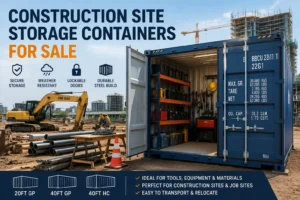
ONE BOX provides 20ft, 40ft, and 40HQ container solutions for storage and export use, including brand-new containers, used containers, one-trip containers, and customized container modification options. Based on your project requirements, we can help you plan the container type, shelving layout, ventilation system, door modification, and export loading solution.
Whether you need a jobsite warehouse, farm storage unit, commercial inventory center, or export container that can be kept for storage after delivery, a 40ft shipping container can deliver long-term value with the right shelving design.
Conclusion: A Good Shelving System Turns a 40ft Container Into a Real Warehouse
A 40ft shipping container is already strong, secure, movable, and cost-effective. But if goods are only stacked on the floor, the container’s full storage value is not being used.
By installing a properly designed heavy-duty shelving system, you can upgrade the container from a basic storage box into an efficient warehouse unit. The key is not simply adding shelves, but planning load capacity, fixing methods, aisle space, ventilation, moisture control, lighting, and safety management.
If your goal is long-term use, faster picking, reduced product damage, and better space utilization, heavy-duty shelving is one of the best upgrades for a 40ft shipping container.
FAQ: Heavy-Duty Shelving in a 40ft Shipping Container
1. How high can shelving be installed inside a 40ft container?
The shelving height should depend on the container’s internal height, the type of goods, and how the items will be accessed. For manual handling, shelves should remain within a safe reachable range. If taller shelving is required, a 40ft High Cube container may be a better choice.
2. Can shelves be fixed directly to container walls?
It is not recommended to rely only on thin side wall panels for load-bearing. A safer method is to transfer weight to the floor and stronger structural points, while using reinforcement plates or floor anchoring to improve stability.
3. Can heavy-duty shelving store palletized goods?
Yes, but palletized goods require proper pallet racking and a more careful load design. Basic shelving is better suited for cartons, tools, small parts, and manually handled goods.
4. Does a 40ft storage container need ventilation?
Yes, ventilation is recommended. Shipping containers can experience condensation due to temperature changes. Vents, exhaust fans, insulation, dehumidifiers, and proper shelf spacing can help reduce moisture problems.
5. Should I install shelves on one side or both sides?
For large or bulky goods, one-side shelving with a wide aisle is usually better. For small parts, cartons, and organized inventory, double-side shelving with a center aisle can provide better space utilization.
6. Can I buy a 40ft container in China, load cargo, export it, and keep the container for storage after delivery?
Yes. Many customers purchase a new or used 40ft container in China, load their goods inside, export it to the destination country, and then keep the container as a warehouse after delivery. This provides both international transport and long-term storage value.